
Mastering Movement and Technique
– Written by Vadim Larramendi
The Hip Joint: The Center of Turnout, Stability, and Technical Precision
Introduction: The Hip as the Core of Technical Movement
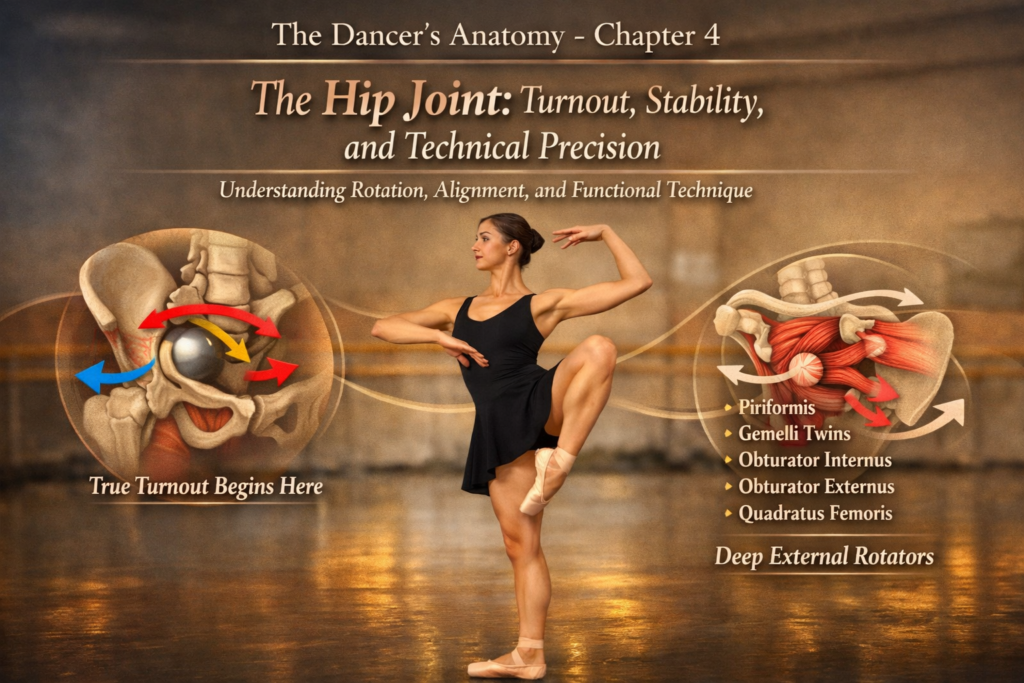
The hip joint is the most influential structure in a dancer’s technique. Its spherical design, three‑dimensional mobility, and direct relationship with the pelvis make it the origin of stability, alignment, and healthy turnout.
This chapter explores the anatomy of the hip (coxofemoral joint), the role of the deep external rotators, the relationship between pelvic placement and technique, and why the hip is the only joint capable of producing true turnout without compromising the dancer’s health.
SEO Keywords: hip joint anatomy, dance biomechanics, healthy turnout, pelvic alignment, deep external rotators, ballet technique, dance injury prevention.
The Coxofemoral Joint: Structure and Function
The hip is a ball‑and‑socket joint, allowing movement in all three anatomical planes:
- Sagittal plane: flexion and extension
- Frontal plane: abduction and adduction
- Transverse plane: internal and external rotation
This three‑plane mobility enables:
- healthy turnout
- high extensions
- clean arabesques
- fluid directional changes
- stability in relevé
- control in turns
The femoral head fits deeply into the acetabulum of the pelvis, creating a stable joint supported by ligaments and a strong capsule. Fine motor control comes from the deep rotator muscles surrounding the joint.
SEO Keywords: hip mobility, ball‑and‑socket joint, dance alignment, arabesque biomechanics.
The Deep External Rotators: The Engines of Turnout
True turnout does not come from the feet or superficial gluteal muscles. It originates from a specific group of deep muscles:
- Piriformis
- Superior gemellus
- Obturator internus
- Inferior gemellus
- Obturator externus
- Quadratus femoris
These muscles:
- generate true external rotation
- stabilize the femoral head inside the acetabulum
- allow turnout without tension
- protect knees and ankles from compensations
When activated correctly, turnout feels light, stable, and sustainable, not forced.
SEO Keywords: deep external rotators, piriformis, turnout muscles, ballet turnout technique.
The Pelvis: The Silent Partner of the Hip
Pelvic placement determines whether the hip can rotate efficiently.
Neutral Pelvis
- allows functional external rotation
- distributes movement without compensations
- stabilizes the spine
- supports clean relevés and turns
Excessive Anterior Tilt
- compresses the lumbar spine
- limits external rotation
- creates false turnout
Excessive Posterior Tilt
- blocks hip mobility
- reduces stability
- affects balance
The pelvis is the bridge between lower‑body technique and upper‑body control.
SEO Keywords: pelvic alignment, dance posture, neutral pelvis, lumbar stability.
Healthy Turnout: Biomechanics and Technique
A healthy turnout is characterized by:
- external rotation originating at the hip
- knee and foot alignment following the femur
- neutral pelvis
- activation of deep rotators
- absence of torsion in knees and ankles
- symmetry between both legs
A forced turnout shows:
- feet opened beyond hip capacity
- knees collapsing inward
- foot pronation
- lumbar tension
- loss of stability
The goal is not to “open more,” but to open better.
SEO Keywords: healthy turnout, turnout alignment, dance injury prevention, ballet technique fundamentals.
The Hip in Key Dance Movements
Plié
Hip alignment controls knee and foot placement. A healthy plié maintains external rotation without collapse.
Relevé
Stability depends on pelvic placement and deep rotator activation.
Arabesque
Posterior extension originates in the hip, not the lower back. The pelvis must remain stable to avoid lumbar compression.
Développé
The hip guides the path of the leg while the torso maintains balance.
Turns
External rotation and pelvic stability are essential for a clean axis.
SEO Keywords: plié alignment, arabesque biomechanics, relevé stability, turn technique.
Hip Care and Longevity for Dancers
To protect the hip and extend a dancer’s career:
- strengthen deep external rotators
- improve capsular mobility
- avoid forcing turnout from the feet
- maintain neutral pelvis
- train functional alignment
- use controlled, non‑extreme stretching
The hip is the foundation of technique. Protecting it means protecting the dancer.
SEO Keywords: dance injury prevention, hip strengthening, rotator training, safe stretching for dancers.
– Written by Vadim Larramendi
Explore More Chapters of The Dancer’s Anatomy
Dive deeper into the art and science of movement through each chapter of the series: