
— Written by Vadim Larramendi Paz
Mastering the Body Through Technique, Awareness, and the Art of Effortless Movement
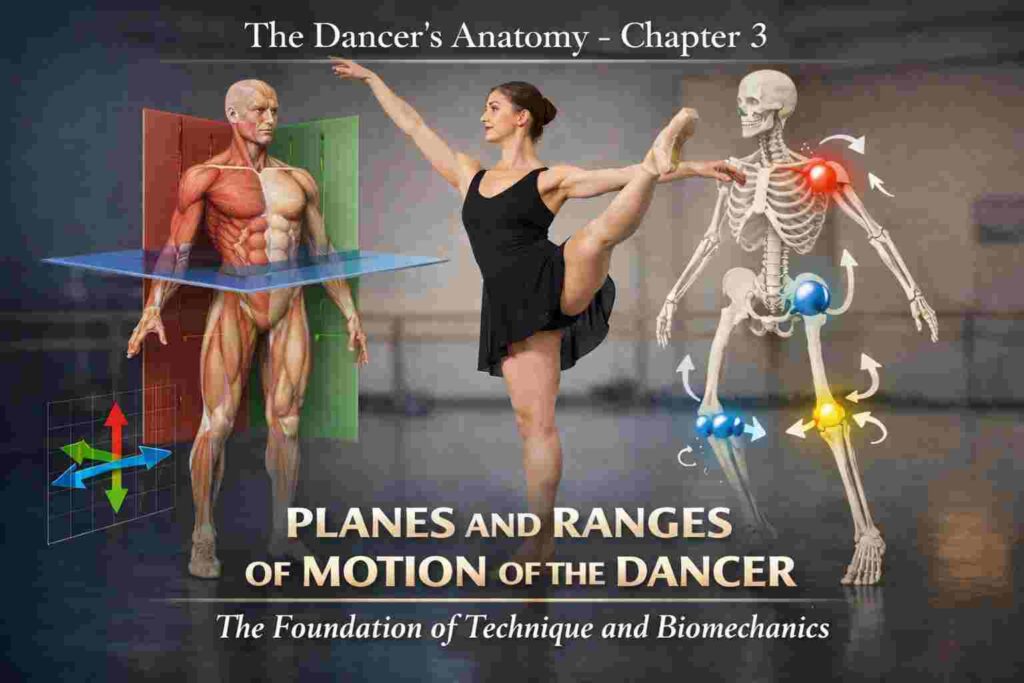
Planes and Ranges of Motion of the Dancer: The Foundation of Technique and Biomechanics
Introduction: Biomechanics as the Foundation of the Dancer’s Movement
Dance is a discipline that combines art, technique, and the science of movement. To perform pliés, relevés, port de bras, turns, jumps, and extensions with precision, a dancer must understand how each joint of the body moves and in which anatomical planes those movements occur.
This chapter establishes the biomechanical foundation that will help explain, in the following chapters, the function of the pelvis, hips, healthy turnout, and also the role of the upper body in posture, stability, and expressive movement.
The Three Planes of Movement: Universal Across All Dance Forms
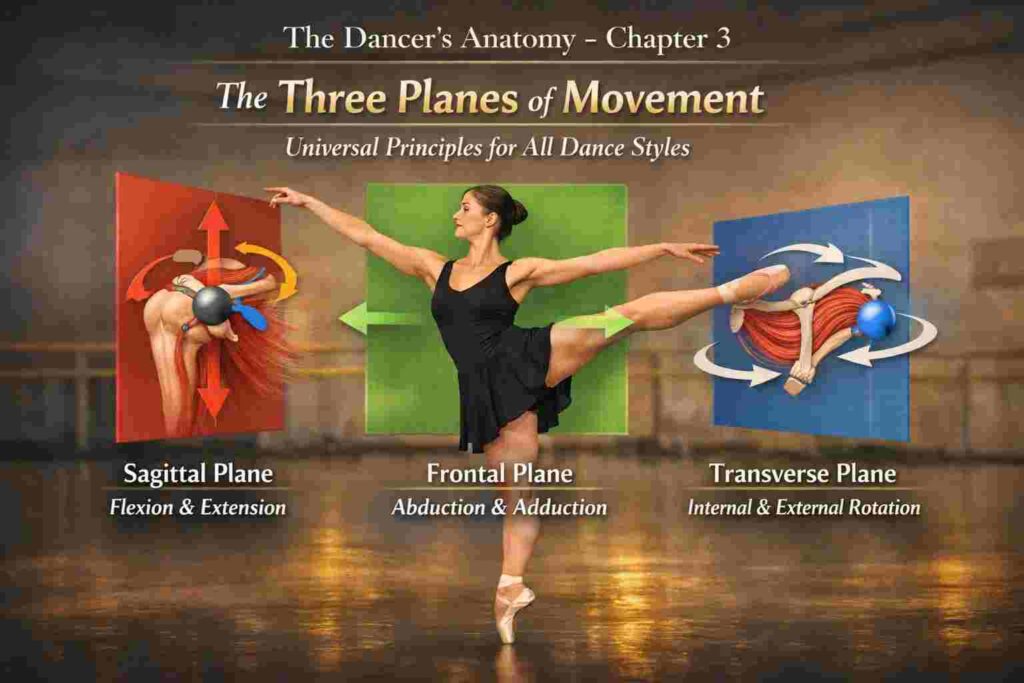
The human body moves in three fundamental planes, and all are essential to dance, regardless of style or technique. Although the transverse plane is key for external rotation in ballet, no plane is less important than another. The laws of human movement are universal and apply equally to:
- classical ballet
- contemporary dance
- jazz
- ballroom
- urban styles
- folk dance
- and all academic and popular dance forms
Sagittal Plane — Flexion and Extension
Seen in:
- plié
- arabesque
- forward and backward cambré
- front port de bras
- forward arm elevation
Frontal Plane — Abduction and Adduction
Seen in:
- tendu to second position
- grand battement à la seconde
- lateral port de bras
- side arm elevation
Transverse Plane — Internal and External Rotation
Seen in:
- turnout
- turns
- spinal rotation
- shoulder rotation
- directional changes
All three planes work together in every dancer’s movement.
Ranges of Motion of the Lower Body
— The Dancer’s Most Complete Joint
Moves in all three planes: flexion, extension, abduction, adduction, internal rotation, and external rotation. It is the only joint of the lower limb capable of producing true turnout.
— Flexion and Extension (with minimal rotation)
It does not rotate significantly. Forcing rotation here causes torsion and risk of injury.
— Combined Movements, No Rotation
Allows dorsiflexion, plantar flexion, eversion, and inversion. Does not allow external rotation.
Ranges of Motion of the Upper Body
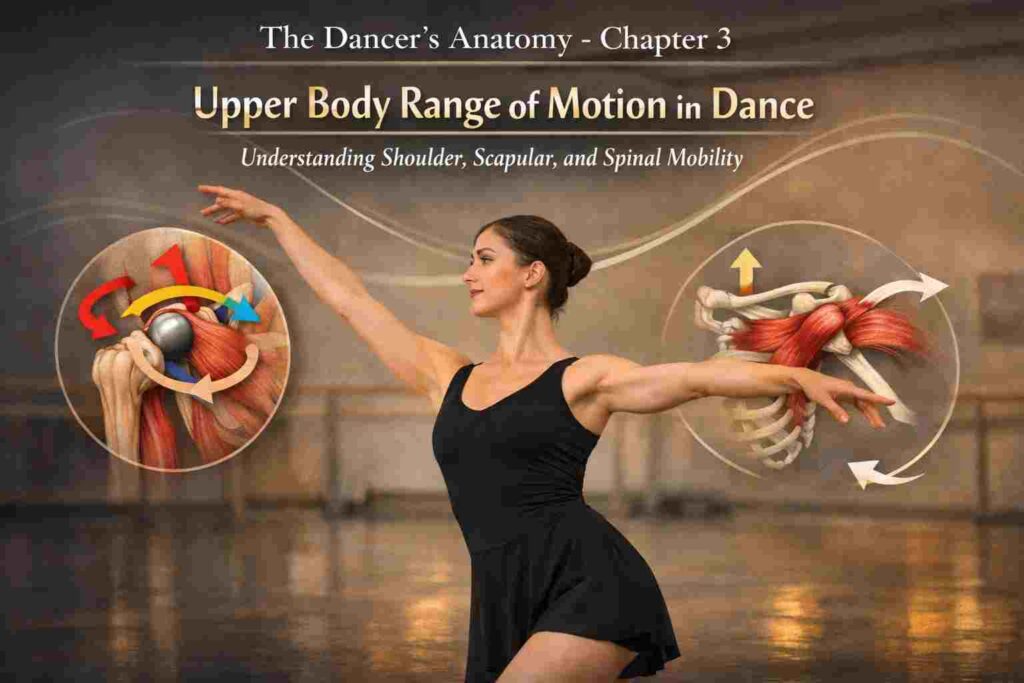
Shoulder (Glenohumeral) — The Most Mobile Joint in the Body
Allows:
- flexion
- extension
- abduction
- adduction
- internal rotation
- external rotation
- circumduction
Essential for long lines, clean port de bras, and balance in turns.
Scapula — Elevation, Depression, Rotation, and Gliding
The scapula acts as the “rudder” of the upper body. Its mobility enables:
- tension‑free arm support
- elegant posture
- neck and thoracic stability
Clavicle — Elevation and Rotation
Connects the arm to the trunk. Moves with every port de bras and arm lift.
Thoracic and Cervical Spine — Flexion, Extension, Rotation, and Lateral Movement
Fundamental for:
- dancer’s posture
- port de bras
- breathing
- balance
- stage lines
Wrist and Hand — Flexion, Extension, and Deviations
Essential for:
- graceful lines
- expression
- movement continuity
- aesthetic port de bras
Why the Hip Is Unique Among All Joints
The hip is the only joint of the lower limb that works fully in all three planes. It differs from:
- the knee (only flexion/extension)
- the ankle (combined movements without rotation)
- the pelvis (stabilizing structure)
Thanks to its spherical design, the hip allows:
- turnout
- high extensions
- directional changes
- stability in relevé
- functional alignment
Applied Biomechanics: Using the Planes of Movement in Daily Technique
Understanding planes and ranges of motion enables dancers to:
- improve alignment
- avoid compensations
- properly activate deep rotators
- maintain a neutral pelvis
- execute clean port de bras
- stabilize the spine
- develop safer, more efficient technique
This knowledge transforms how dancers move, train, and care for their bodies.
— Written by Vadim Larramendi Paz
Explore More Chapters of The Dancer’s Anatomy
Dive deeper into the art and science of movement through each chapter of the series: