
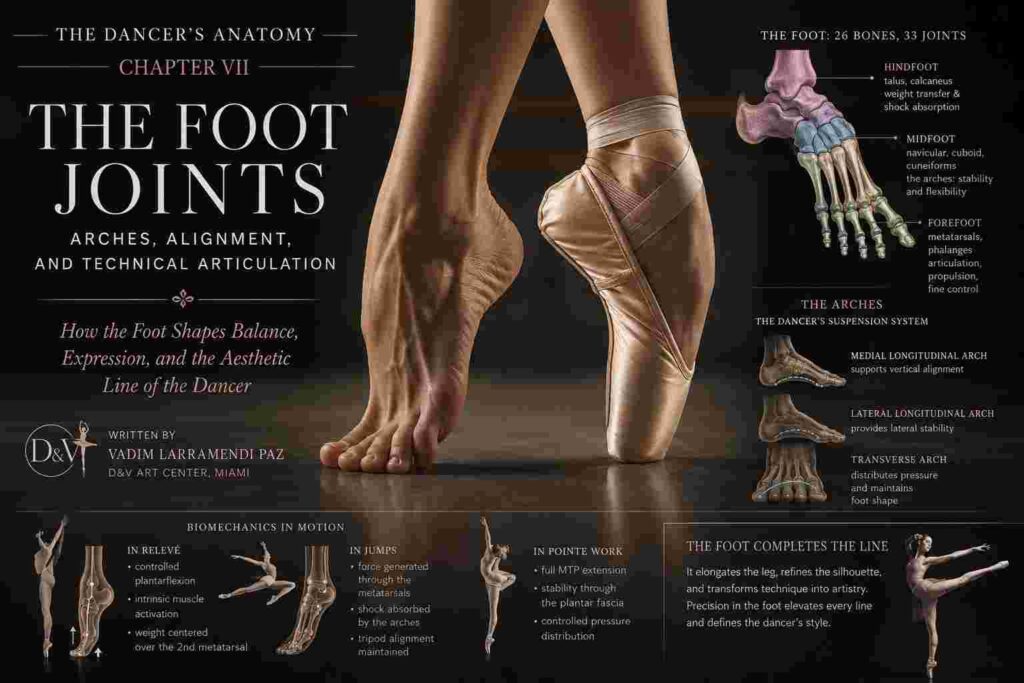
The Foot Joints: Arches, Alignment, and Technical Articulation
– Written by Vadim Larramendi Paz – D&V Art Center, Miami
How the Foot Shapes Balance, Expression, and the Aesthetic Line of the Dancer
Introduction: The Foot as the Dancer’s Instrument
The foot is the dancer’s most expressive and complex structure. With 26 bones and 33 joints, it forms a dynamic system that supports balance, absorbs impact, and articulates movement with precision. Every plié, relevé, and jump begins and ends in the foot — it is the final translator of technique into motion and the finishing point of the dancer’s line.
The Foot Joints: Structure and Function
The foot is divided into three regions:
1. Hindfoot
- talus and calcaneus
- responsible for weight transfer and shock absorption
- includes the subtalar joint (inversion/eversion)
2. Midfoot
- navicular, cuboid, and three cuneiforms
- forms the arches
- provides flexibility and stability during transitions
3. Forefoot
- metatarsals and phalanges
- enables articulation, propulsion, and fine control in pointe work and jumps
Major Articulations of the Foot
Subtalar Joint
Controls inversion and eversion — essential for balance and safe landings.
Transverse Tarsal Joint (Midtarsal Joint)
Allows the foot to adapt to surfaces and maintain alignment.
Metatarsophalangeal Joints (MTP)
Responsible for toe articulation in relevé, jumps, and pointe technique.
Interphalangeal Joints
Enable fine control of toe flexion and extension.
The Arches of the Foot: The Dancer’s Suspension System
Medial Longitudinal Arch
Supports vertical alignment in relevé.
Lateral Longitudinal Arch
Provides lateral stability.
Transverse Arch
Distributes pressure evenly and maintains foot shape.
Biomechanics of the Foot in Dance
In Relevé
- controlled plantarflexion
- intrinsic muscle activation
- weight centered over the second metatarsal
In Jumps
- force generated through the metatarsals
- shock absorbed by the arches
- tripod alignment maintained
In Pointe Work
- full MTP extension
- stability through the plantar fascia
- controlled pressure distribution
The Foot and the Continuity of the Leg Line
Beyond biomechanics, the foot completes the visual line of the leg, shaping the dancer’s silhouette and aesthetic impact. A beautifully articulated foot:
- elongates the leg’s axis,
- refines the contour of tendu, arabesque, and développé,
- enhances the illusion of length and elegance,
- and transforms technical movement into artistic expression.
The instep, the articulation of the toes, and the alignment of the ankle all contribute to the dancer’s aesthetic signature. When the foot finishes the movement with precision — whether in demi‑pointe, pointe, or flat — it elevates the entire line of the leg and defines the dancer’s style.
Common Technical Errors
- collapsed arches
- over‑pronation or supination
- uneven weight distribution
- excessive toe gripping
- misaligned metatarsals
Injury Prevention and Conditioning
Frequent Injuries
- plantar fasciitis
- metatarsalgia
- sesamoiditis
- stress fractures
- flexor hallucis longus tendinopathy
Preventive Strategies
- strengthen intrinsic foot muscles
- maintain arch integrity
- stretch the plantar fascia
- train proprioception
- use controlled landings
Conclusion: The Foot as the Final Expression of Technique
The foot is the dancer’s foundation and finishing touch. Its joints, arches, and muscles transform anatomical precision into elegance, balance, and expressive artistry. A strong, aligned, beautifully articulated foot ensures longevity, safety, and aesthetic excellence.
– Written by Vadim Larramendi Paz – D&V Art Center, Miami