
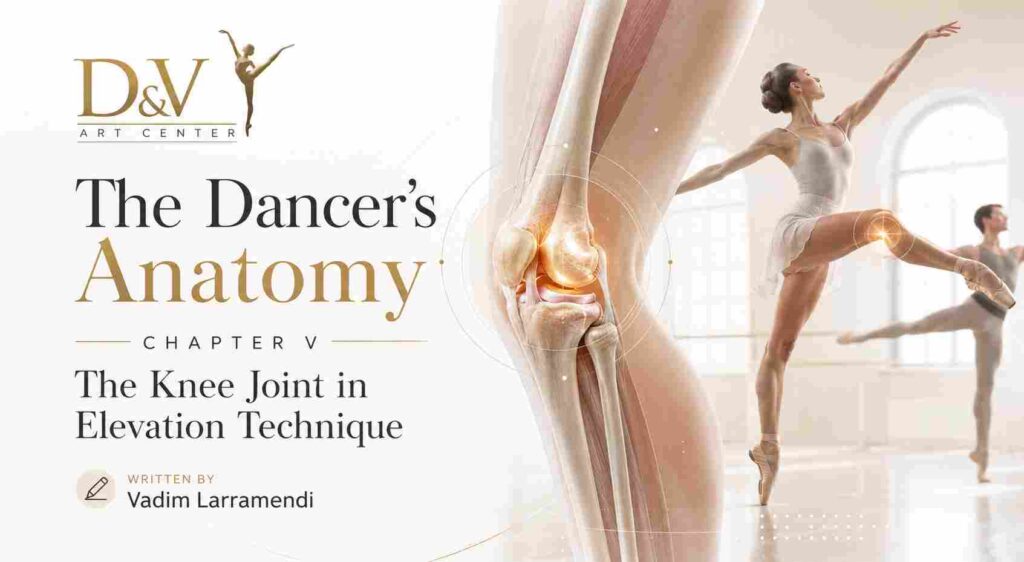
– Written by Vadim Larramendi
Understanding Stability, Extension, and Control in the Relevé
Introduction: The Knee as the Axis of Elevation
The knee joint is the silent architect of elevation. Every relevé, every sustained balance, and every controlled rise depends on the knee’s ability to stabilize, align, and transfer force from the foot to the pelvis.
Unlike the hip — a multidirectional joint — the knee is a precision hinge, designed for flexion, extension, and subtle rotational adjustments that are almost imperceptible, protecting the dancer during vertical movements.
In elevation technique, the knee becomes the bridge between power and elegance, transforming muscular force into height, balance, and clean lines.
The Knee Joint: Structure and Functional Design
The knee is formed by three primary components:
- Femur
- Tibia
- Patella
However, understanding stability in dance requires acknowledging a fourth structural element:
The Fibula (Peroneal Bone)
A long, slender bone running parallel to the tibia. Although it does not participate in the main femoro‑tibial hinge, it is functionally connected to the knee because:
- Its proximal end articulates with the tibia, just below the lateral aspect of the knee.
- This articulation — the proximal tibiofibular joint — is part of the functional knee complex.
- It contributes to lateral stability.
- It allows micro‑rotational adjustments.
- It anchors the peroneal muscles, essential for ankle stability and clean relevé mechanics.
Global Stability Components
- ACL, PCL, MCL, LCL
- Medial and lateral menisci
- Quadriceps and hamstrings
- Fibula and peroneals
- Joint capsule and tendons
The Role of the Knee in Elevation Technique
Elevation is a coordinated biomechanical event involving:
- Ankle plantarflexion
- Knee extension
- Hip stabilization
- Core engagement
The knee maintains alignment, prevents collapse, distributes load, and supports axis control.
A stable knee produces a clean, silent, effortless relevé. An unstable knee reveals wobbling, torsion, loss of height, and instability in turns and balances.
Key Muscles for Knee Stability in Relevé
Quadriceps (VMO)
Controls extension and patellar alignment.
Hamstrings
Balance anterior tension and protect the joint capsule.
Gastrocnemius
Crosses the knee and contributes to elevation.
Gluteus Medius & Deep Rotators
Prevent internal femoral rotation.
Peroneals
Anchored to the fibula, they stabilize the ankle and prevent excessive pronation.
Alignment Principles for a Healthy Relevé
A correct relevé requires:
- Full knee extension
- Patella aligned with the second toe
- Neutral pelvis
- Even weight distribution
- Turnout initiated from the hip
Common errors include hyperextension without control, inward knee drift, forced turnout, collapsing arches, and rising with a bent knee.
The Knee in Key Elevation Movements
Relevé
Extension and alignment throughout the rise and descent.
Piqué
Precise extension to maintain height and axis.
Soutenu Turn
Knee alignment determines turn cleanliness.
Arabesque on Pointe
The supporting knee provides vertical lift and prevents torsion.
Passé Relevé
The knee stabilizes the axis while the hip manages turnout.
Care and Longevity of the Knee for Dancers
To protect the knee and enhance elevation technique:
- Strengthen quadriceps and VMO
- Balance hamstring activation
- Avoid forcing turnout
- Maintain a neutral pelvis
- Train slow, controlled relevés
- Improve ankle mobility
- Avoid hyperextension without muscular support
- Do not let the arches collapse — maintain active plantar support
- Consider congenital variations such as bow‑legs (genu varum) or knock‑knees (genu valgum): these do not prevent dance, but require conscious muscular compensation through strengthening of the gluteus medius, deep rotators, peroneals, and VMO
A healthy knee is the foundation of elevation. Protecting it means protecting the dancer’s future.
– Written by Vadim Larramendi
Explore More Chapters of The Dancer’s Anatomy
Dive deeper into the art and science of movement through each chapter of the series: