
— Written by Vadim Larramendi Paz
Mastering the Body Through Technique, Awareness, and the Art of Effortless Movement
Prologue to the Series “Anatomy and Kinesiology for Dance” – D&V Art Center, Miami
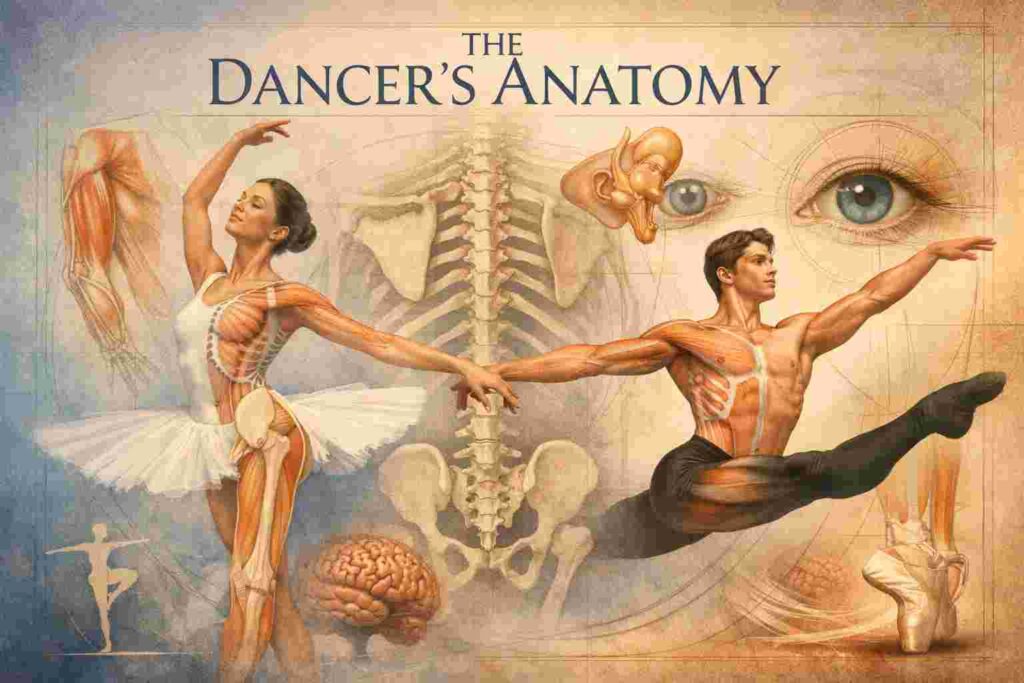
Dance is an art form where the body becomes instrument, language, and emotion. Yet behind every fluid movement, every controlled turn, and every jump that seems to defy gravity, there is a complex anatomical structure and a refined training process that blend science, technique, and artistic sensitivity.
Understanding this anatomy—the structure, the musculature, and the sensory systems that guide the dancer—is essential for training intelligently, preventing injuries, and achieving the level of mastery where effort becomes invisible and only beauty remains.
This article opens our educational series exploring anatomy, joints, and kinesiology applied to dance from a modern, conscious, and professional perspective.
1. The Dancer’s Body: An Integrated System That Creates Art
A dancer does not move in isolated parts. The body functions as an integrated system where:
- The skeletal system provides structure
- The postural muscles shape alignment and control movement
- The sensory system orients the dancer in space
- Technique transforms effort into lightness
- Expression turns precision into art
This holistic approach is the foundation of safe, efficient, and aesthetically elevated training.
2. The Skeletal System: Passive Structure, Not Posture
The skeleton defines proportions, lengths, and joint ranges, but it does not determine posture or technical quality.
In dance, the skeletal system:
- Establishes natural limits
- Allows joint mobility
- Supports body weight
- Serves as an anchor for muscles and ligaments
But it does not correct alignment or hold positions. Bones do not shape posture—posture is built by the deep muscular system.
3. Postural Muscles: The True Architects of Technique
A dancer’s posture is a trained skill, not an anatomical gift. The deep postural muscles are responsible for:
- Maintaining alignment against gravity
- Stabilizing the pelvis and spine
- Controlling turnout without forcing joints
- Sustaining balances and turns
- Preventing compensations that lead to injury
Key postural muscles include:
- Transverse abdominis
- Multifidus
- Deep spinal erectors
- Psoas–iliacus
- Gluteus medius
- Deep adductors
- Deep external rotators of the hip
- Tibialis posterior and intrinsic foot muscles
When these muscles work in harmony, the dancer develops:
- Control
- Stability
- Elegance
- Clean technique
- Safe and efficient movement
4. The Sensory System: The Dancer’s Internal Compass
Movement does not exist without perception. A dancer must know where they are, how they are moving, and what surrounds them. This is the role of the sensory system—the body’s internal GPS.
4.1 Proprioception: The Sense of Movement
Proprioception allows the dancer to feel body position without looking. It is essential for:
- Holding an arabesque with stability
- Adjusting a turn in milliseconds
- Maintaining center
- Correcting alignment without mirrors
4.2 Vestibular System: Balance in Motion
Located in the inner ear, it enables:
- Clean turns
- Stable landings
- Controlled directional changes
4.3 Visual System: External Reference
Vision guides:
- Lines
- Directions
- Distances
- Group coordination
4.4 Tactile System: Sensitivity and Control
Touch informs:
- Pressure through the feet
- Contact with the floor
- Connection with a partner
5. The Aesthetic of Effortless Complexity: The Signature of a True Dancer
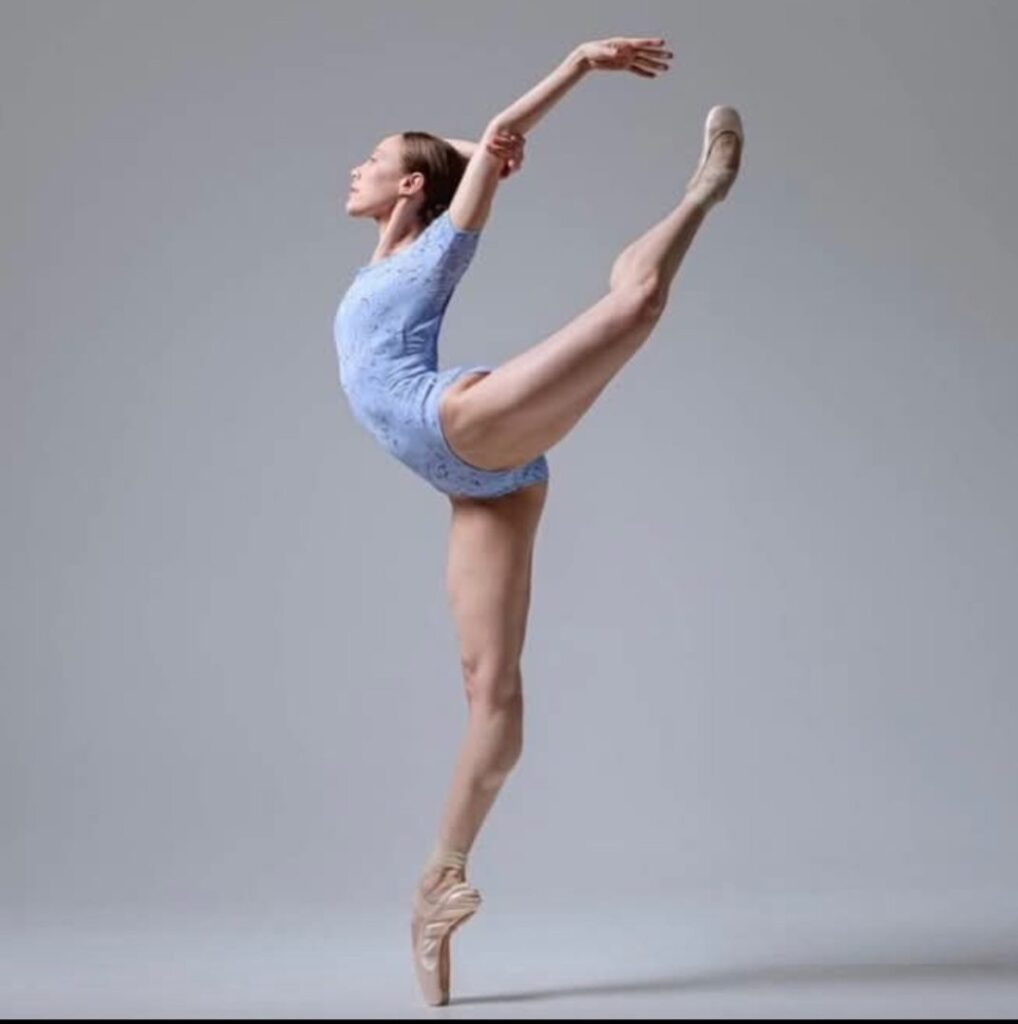
One of the highest principles in dance is the ability to perform movements of extreme technical difficulty without showing effort. The audience should see:
- serenity
- fluidity
- control
- beauty
- joy
Even when the dancer’s body is working at maximum capacity.
This illusion is possible because:
- Postural muscles support without rigidity
- The sensory system guides balance and orientation
- Technique distributes effort efficiently
- Breath integrates with movement
- The mind remains calm and focused
Dance is an art where technique becomes invisible so emotion can be revealed. The dancer transforms the difficult into the natural, the complex into the light, and the physical into the poetic.
6. Posture in Dance: A Sensory–Muscular Construction
Posture is not static—it is a dynamic process shaped by three systems:
- Skeletal system → structure
- Postural muscular system → support and control
- Sensory system → orientation and adjustment
When these systems work together, the dancer can:
- Turn with stability
- Jump with power and land softly
- Hold extensions without visible tension
- Move with fluidity and precision
- Convey peace even in highly demanding choreography
7. What’s Coming in This Educational Series
This prologue opens the door to a series that will explore:
- The hip and healthy turnout
- The knee and alignment in pliés and jumps
- The ankle and foot as the foundation of balance
- The spine and center control
- Kinesiology applied to turns, jumps, and extensions
- Postural muscle training for dancers
- The art of effortless movement
- Injury prevention for young and adult dancers
Each article is designed to help dancers, parents, and teachers understand dance through a scientific, artistic, and pedagogical lens.
Conclusion
The dancer’s anatomy is a universe where structure, strength, perception, and expression merge to create art. Understanding the body not only improves technique—it transforms how the dancer moves, trains, and expresses themselves.
At D&V Art Center, our mission is to develop conscious, disciplined, and technically solid artists. This series will be a key tool on that journey.
— Written by Vadim Larramendi Paz
Explore More Chapters of The Dancer’s Anatomy
Dive deeper into the art and science of movement through each chapter of the series: