
– Written by Vadim Larramendi
Mastering the Body Through Technique, Awareness, and the Art of Effortless Movement
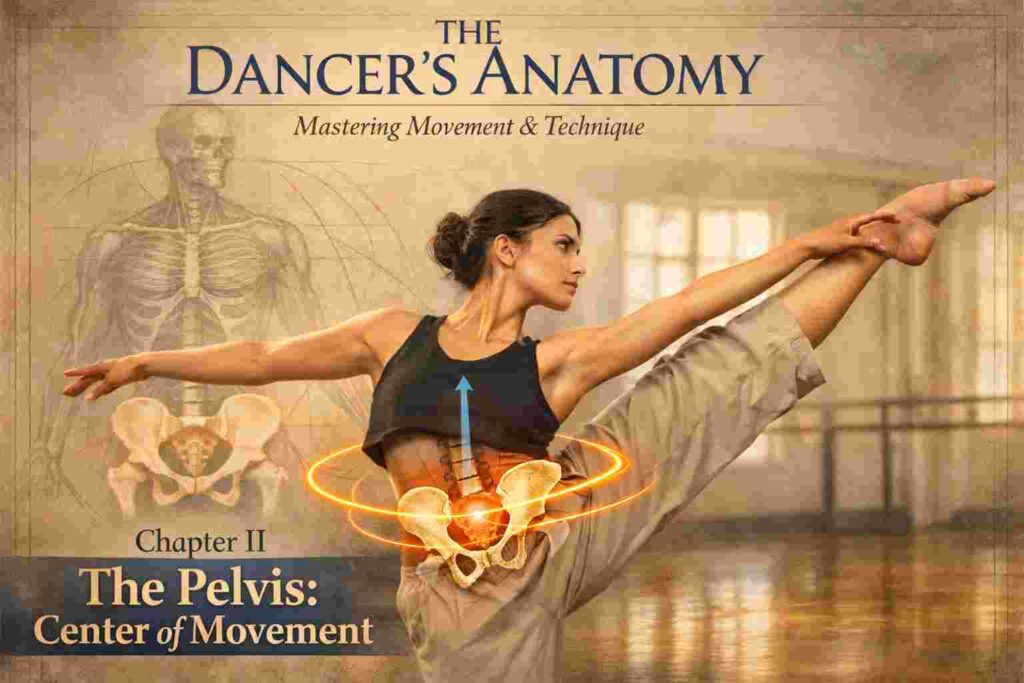
Pelvis: Center of Movement, Posture, Direction, and the Dancer’s Core Alignment
The pelvis is the biomechanical center of the dancer’s body, the place where alignment, balance, stability, and movement initiation converge. In dance science, the pelvis is recognized as the primary center of gravity, the point from which the dancer organizes posture, controls weight transfer, and generates efficient movement. Understanding pelvic alignment is essential for proper dance technique, injury prevention, and effortless movement quality.
-
The Pelvis as the Body’s Control Center
In dance training, the pelvis functions as the central stabilizer that allows the limbs to move with precision. A well‑aligned pelvis supports:
- clean turns and pirouettes,
- safe landings in jumps,
- controlled extensions,
- full‑body coordination,
- and optimal dance posture.
This makes pelvic alignment one of the most important components of proper dance technique and body mechanics for dancers.
-
Pelvic Neutrality: Foundation of Proper Dance Posture
Pelvic neutrality is a key concept in dance alignment and postural training for dancers. It is a balanced position where:
- the lumbar spine stays long without overarching,
- the deep core supports the pelvis,
- the sacrum drops naturally,
- the iliac crests remain level,
- and weight is evenly distributed through the feet.
A neutral pelvis creates the foundation for correct dance posture, allowing the spine to align, the torso to lift, and the upper body to move freely.
-
The Pelvis as the Generator of Movement
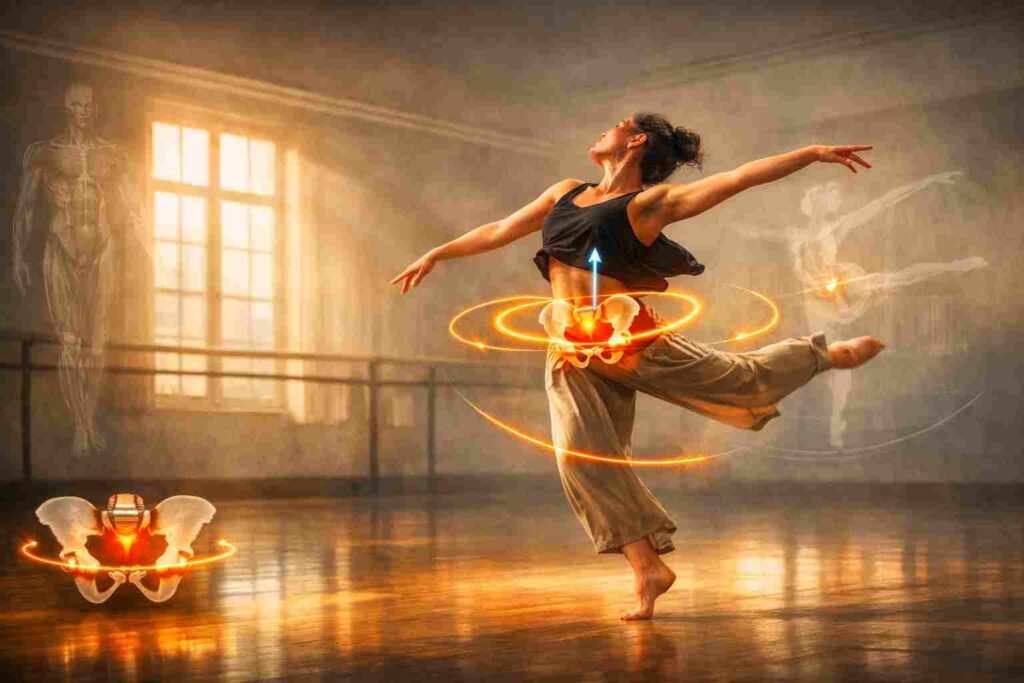
In dance biomechanics, movement originates from the pelvis—not the legs or shoulders. The pelvis initiates:
- turnout from the hip,
- balances and weight shifts,
- cambers and torso articulation,
- dynamic transitions,
- and fluid, expressive movement.
This concept is central to kinesiology for dancers and helps create movement that looks effortless and controlled.
-
The Pelvis as the Starting Point for Directional Changes
One of the most important principles in dance movement analysis is that the body changes direction from its center of gravity, not from the feet or upper body.
Because the pelvis houses the center of gravity:
- it leads directional changes,
- it organizes the torso,
- and it determines the pathway of movement through space.
When the pelvis leads:
- transitions are smooth,
- balance is maintained,
- movement becomes efficient,
- and the dancer travels with clarity and intention.
This is a core concept in movement efficiency for dancers and advanced dance technique.
-
Pelvis–Core Integration: Architecture of the Dancer’s Posture
The dancer’s posture is built from the pelvis–core connection, not from the shoulders or chest.
This integrated system includes:
- the transverse abdominis,
- the multifidus,
- the diaphragm,
- and the pelvic floor.
Together, they create the internal support needed for:
- stable alignment,
- controlled movement,
- lifted posture,
- and the signature “suspended” quality seen in professional dancers.
This is essential for core strength for dancers and safe dance technique.
-
The Dancer’s Posture: Alignment Built from the Center
Proper dance posture is a three‑dimensional alignment system.
A well‑organized posture shows:
- a clear vertical axis,
- a neutral pelvis,
- integrated ribs,
- anchored scapulae,
- a long, free neck,
- and upward energy through the spine.
This posture supports balance, turnout, flexibility, and movement control.
-
Common Errors in Pelvic Alignment and Dance Posture
Frequent alignment mistakes include:
- excessive pelvic tuck,
- anterior pelvic tilt,
- rib flaring,
- turnout forced from the knees,
- collapsing during relevés or turns,
- initiating direction from the shoulders instead of the pelvis.
Correcting these errors is essential for injury prevention in dancers and proper dance alignment.
-
The Pelvis as the Bridge Between Technique and Expression
When the pelvis is aligned:
- the torso moves freely,
- breath supports musicality,
- port‑de‑bras becomes expressive,
- and movement gains elegance and artistry.
This connection between biomechanics and artistic expression is what elevates a dancer’s performance.
Conclusion
The pelvis is the dancer’s command center—the origin of posture, the generator of movement, and the starting point for directional changes. Mastering pelvic alignment enhances technique, efficiency, artistry, and long‑term physical health, making it one of the most important foundations in dance training.
– Written by Vadim Larramendi
Explore More Chapters of The Dancer’s Anatomy
Dive deeper into the art and science of movement through each chapter of the series: